
 English (UK)
  Nederlands
  Deutsch
  Français
  Español
  Polski
  Italiano
 - News
Motorhome tuning, sense or nonsense?
Read this CaravanRepair article about motorhome tuning: fact or fiction? If you have damage or a question as a result, please use the form so that your message can be assessed properly right away.
REPORT DAMAGE WITHOUT OBLIGATION
(also use this form for damage you have already reported)
- Certified dealer network
- Over 25 years of experience

Camper Tuning. We went to visit one of the better camper (camper) tuners in the Benelux, the Dutch firm Bullpower from Dronten.
Does mobile home tuning make sense? And if so, what’s the point? For all these questions, we will try to provide you with an honest and objective answer.
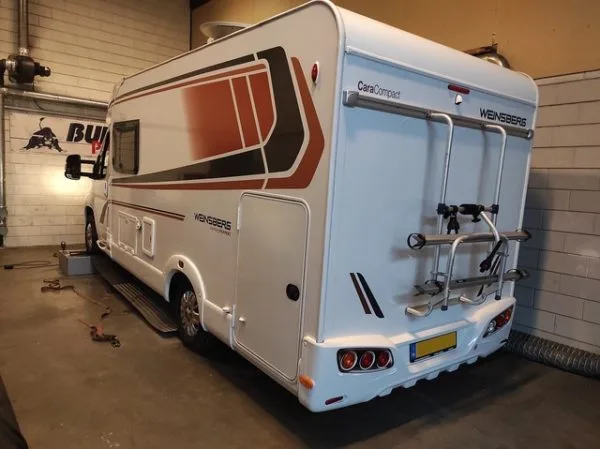
Motor tuning or motorhome tuning is becoming more common and increasingly frequent. Even the motorhome owner would like more power, but also to drive more economically. On the one hand, motorhomes are becoming ever more luxurious and therefore fuller and heavier. On the other hand, people also want to drive nicely, smoothly and more efficiently during their holidays. Motorhome tuning could therefore be a solution. As soon as the first hills appear or the wind picks up (against), all momentum is often lost and fuel consumption rises significantly. In many cases, the superstructure on a standard chassis has become too large and too heavy due to all the extra features and accessories on the motorhome. The weight and often also the large frontal surface area of the motorhome’s bodywork, together with the high air resistance that comes with it, make it difficult to keep pace with the rest of the traffic—especially if you want to drive calmly and smoothly at low engine revs. There has already been a great deal—and often, if not too often, written—about engine tuning in general. However, we felt it was right to take another closer look at motorhome tuning specifically. And that was not entirely without success.
What does a specialist do? First and foremost, they don’t talk about tuning, but about fine-tuning. They make use of the ECU’s fine-tuning features, the so-called engine management. This Electronic Control Unit (ECU) ensures that your engine isn’t set to an average, but is better matched to your needs and driving style.
You want to be able to drive comfortably and smoothly under all circumstances, with the right amount of pulling power at the right time, responsiveness, and the lowest possible fuel consumption. The ECU keeps track of, among other things, engine speed, engine temperature, intake outside air, added fuel, and the available oxygen content. Based on this, among other things, the ignition timing, the amount of fuel required, and other factors are determined.
The modern motorhome is sold in many countries, where fuel composition and quality can vary. In addition, maintenance intervals are handled differently from country to country. Manufacturers therefore build in safety margins to prevent poorer fuel, oil, or maintenance from leading to severe engine damage. On top of that, the constant drive for more fuel-efficient engines and stricter environmental standards forces manufacturers to manage fuel delivery and emissions ever more precisely.
Air temperature, atmospheric pressure and average driving behaviour also play a role. In some countries, even for fiscal reasons, the ECU unit is adjusted. The manufacturer therefore opts for a balanced middle ground. In Western Europe, fuels and conditions are generally favourable. This means that safety margins can be fine-tuned within acceptable limits, without any impact on the engine’s service life. Within those margins, there is enough room to optimise your motorhome. With a proper fine-tuning, the manufacturer’s safety margins are not exceeded.
With an assignment from the insurance channel, we set out and tested various tuners across the Benelux. We did this for two reasons: to check whether tuning could be harmful for insurance-related reasons, and to assess whether it is actually worthwhile. Of the 28 motorhomes we tested, we asked the owners about their findings and conclusions.
We came to a striking result. With 4 tested motorhomes, there was no noticeable or measurable result on the test bench, even though an average of €600 had been paid. With 8 tested motorhomes, the result was no more than a few extra hp, with barely any additional measurable torque. In the case of 3 vehicles, the owners said their motorhome had been tuned, but on inspection it quickly became clear that this was not possible: these older vehicles did not have electronic engine control. The fuel pump had been misaligned. This did provide more power, but also a significantly higher fuel consumption.
There were also positive results. Most convincing was that 13 tested motorhomes had been carried out independently of each other at the same company. Curious after the stories from the motorhome owners, we visited the company in the Netherlands without prior notice. It quickly became clear what we were dealing with: everything was neatly taken care of, and they explained clearly what engine tuning, or as they prefer to call it, fine-tuning, precisely involves. It was also made clear that modifications without their own test rig can never result in a proper vehicle or fine-tuning setup. For more information, click here.
Conclusion about motorhome tuning
With this article, we wanted to demonstrate that tuning or fine-tuning a motorhome really is specialist work.
- A. A proper fine adjustment should be carried out by a specialist.
- B. If properly adjusted according to the standards of a good tuner, this should not have any adverse effects on your motorhome.
A good tuner writes and makes their own programmes and tests them continuously on the test bench. We therefore do not want to withhold this Dutch company’s address details from you.
Need more information?
Bullpower
Fight 14
8253 PH Dronten
www.bullpower.nl
Latest news
Unique Hail-resistant Coating
About a unique hail-resistant coating for caravan and motorhome roofs, with protection against hail damage, roof leaks and moisture damage.

Inject/repair caravan floor
Explanation of injecting or repairing a caravan floor, sprung floors, and when a specialist assessment is advisable.
Training Caravan Technician
About the caravane technician and caravan side damage specialist training at CaravanRepair®.
Motorhome tuning, sense or nonsense?
Camper van tuning: does engine fine adjustment make sense for motorhomes and what should you watch out for?
Our specialists know all the secrets for the best caravan and motorhome insurance.
About caravan and camper insurance, new-for-old coverage, purchase value coverage, market value and repairs via your own dealer.